Equity Signal Research / Model Risk

AXIOM Quant Research Portfolio

A research-grade case study in turning an overfit equity-signal prototype into a disciplined validation workflow: causal features, purged walk-forward testing, explicit execution costs, baseline comparison, and auditability.

Net Strategy Return
+1.84%
Fixed logistic signal after cost and slippage.
Strategy Sharpe
0.097
Not competitive with passive exposure.
Buy-Hold Return
+64.20%
Equal-weight baseline over same dates.
Spearman IC
0.0073
Small positive rank signal.
Deflated Sharpe
-0.707
Adjusted for 41 lower-bound trials.
Turnover
10.72%
Average daily turnover after thresholding.
Research Question

Can daily OHLCV features produce an economically meaningful equity signal?

The result is intentionally not dressed up: the model shows a tiny positive IC, but the strategy fails to beat the passive benchmark and does not survive multiple-testing-aware Sharpe adjustment.

Method Total Return Ann. Sharpe Max Drawdown Interpretation
Fixed logistic signal, net +1.84% 0.097 -10.21% Statistically faint; economically weak after costs.
Equal-weight buy-hold +64.20% 0.646 -14.95% Passive exposure dominates this simple alpha attempt.
Zero-skill random, net -15.74% -3.499 -16.42% Cost drag baseline with similar active rate.
Validation Architecture

Controls that make the result harder to fool

The research harness favors falsification over flattering performance. Each transform is fit inside the training fold, decisions lag execution, and benchmark comparisons use the same downloaded universe.

Fold-local preprocessingStandardScaler is inside the sklearn pipeline and fit only on training slices.
Purged walk-forward CV504-day minimum train windows, 63-day validation windows, 5-day purge, and 5-day embargo.
Execution lagSignals use close[t] information; fills occur at open[t+1] with exit at close[t+1].
Cost model5 bps transaction cost plus 5 bps slippage per side, applied to active positions.
DiagnosticValue
IC t-stat2.19
Active hit rate53.47%
Active fraction5.36%
Configuration lower bound41
DSR probability1.79e-235
Research Evidence Stack

What should be displayed and why

The page focuses on diagnostics that answer research questions: whether the strategy beats baselines, whether the score is monotonic across buckets, and whether signal quality is stable through time.

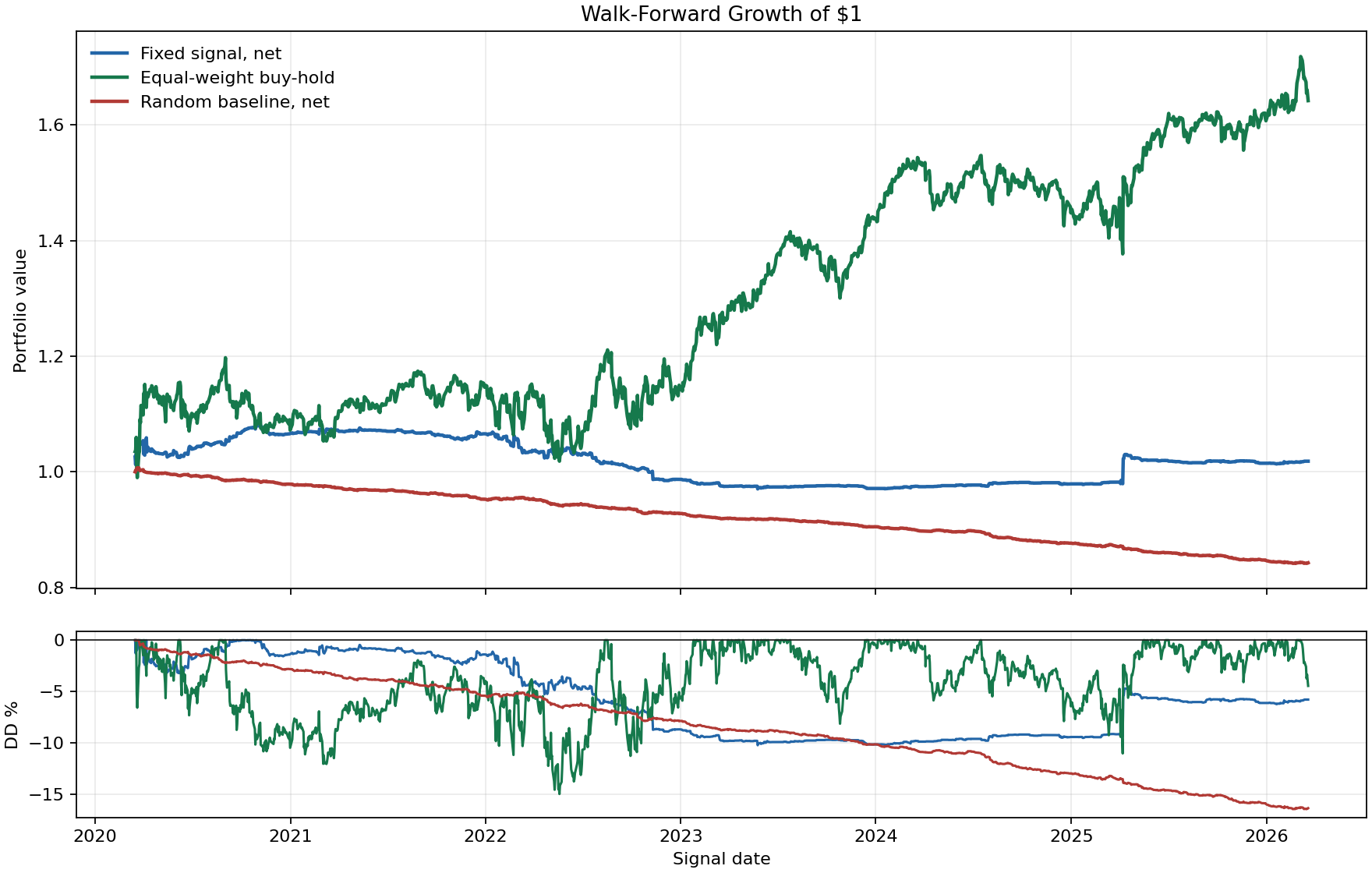
Equity curves for strategy, buy-hold baseline, and random baseline
Performance and drawdown. The fixed signal ends slightly positive but is dominated by equal-weight buy-hold; the drawdown panel shows that the small net return is not compensation for a clearly better risk profile.
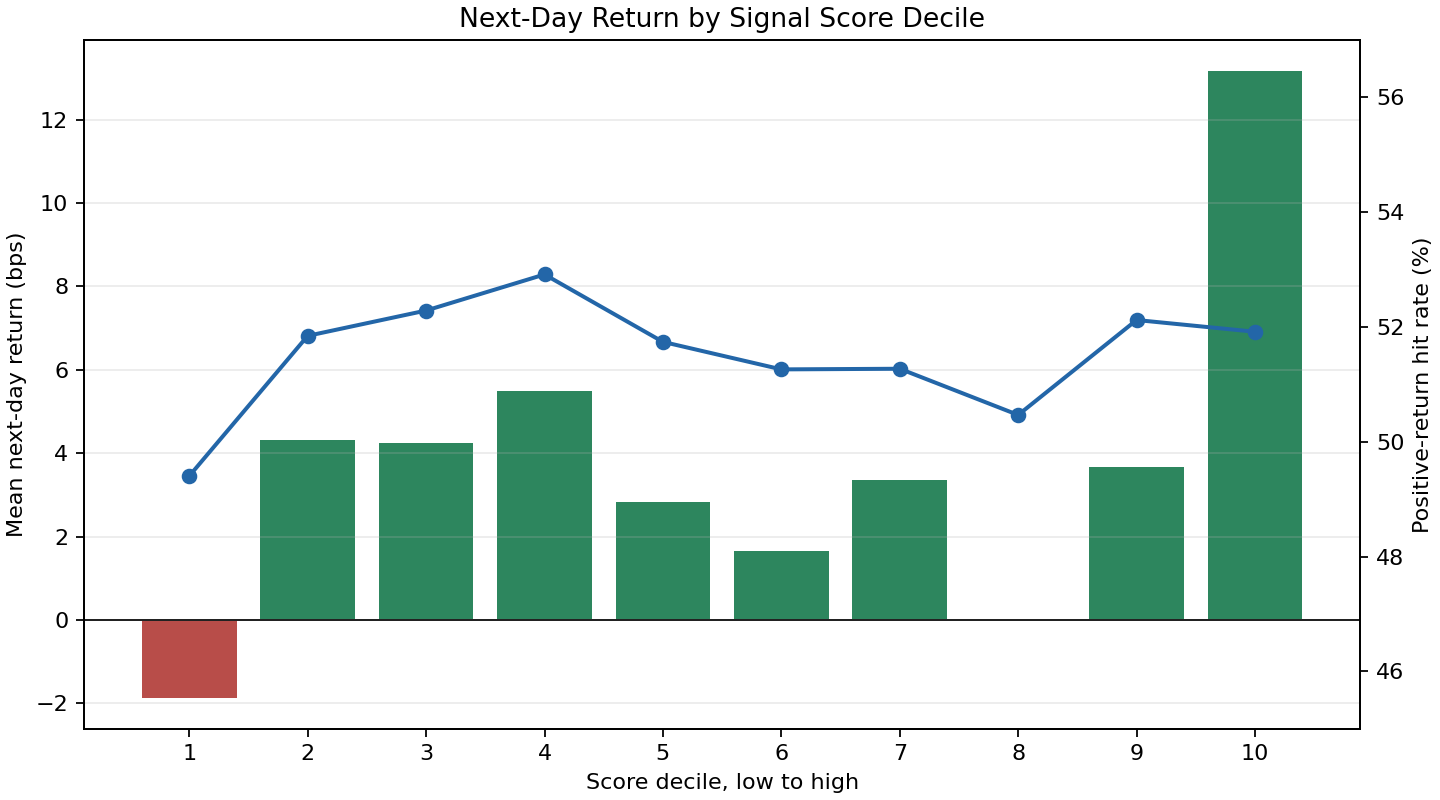
Bar chart of next-day return by signal score decile with hit-rate line
Score monotonicity. The top decile has the strongest realized return, but middle buckets are noisy; this supports a weak, non-production signal interpretation.
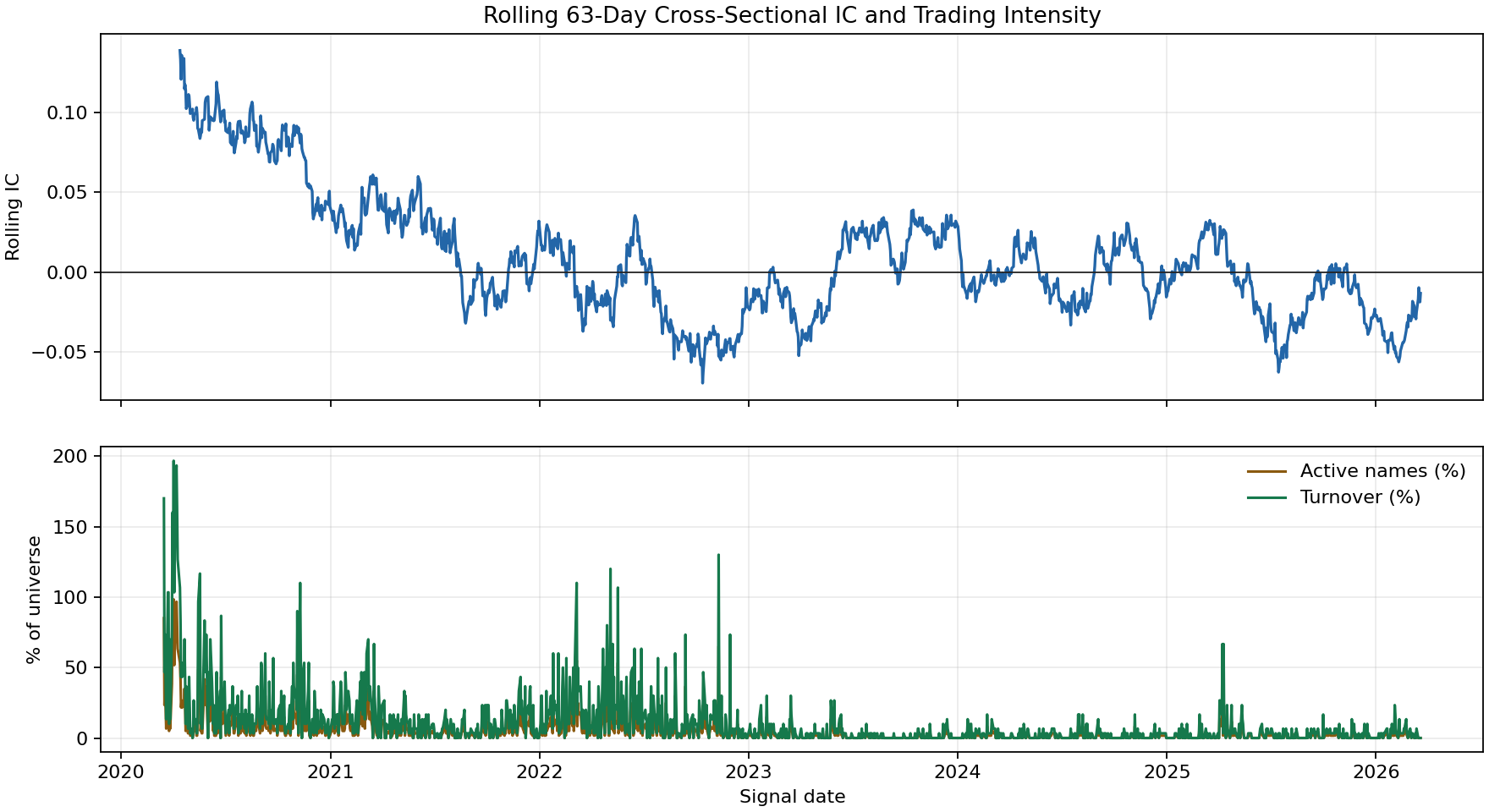
Rolling IC and trading intensity over time
Signal stability and trading intensity. Rolling IC decays and oscillates around zero while turnover spikes early; the signal is not stable enough to justify a strong performance claim.
Audit Trail

Model risk findings retained for reviewers

Earlier experiments are preserved because they show how impressive-looking metrics can emerge from narrow universes, same-bar assumptions, and repeated configuration search.

Selection biasLegacy runs focused on four high-attention tickers and PLTR-only variants.
Preprocessing leakageSeveral early scripts fit scalers or thresholds on full datasets before splits.
Execution realismThe validated harness adds next-day execution and explicit cost/slippage assumptions.